Suburban Pets · Academic Research Project · Team of 3
Pet owners were calling — not booking online.
A three-person study of a Long Island pet-care business whose customers trusted the service, but not the site — and what should change next.
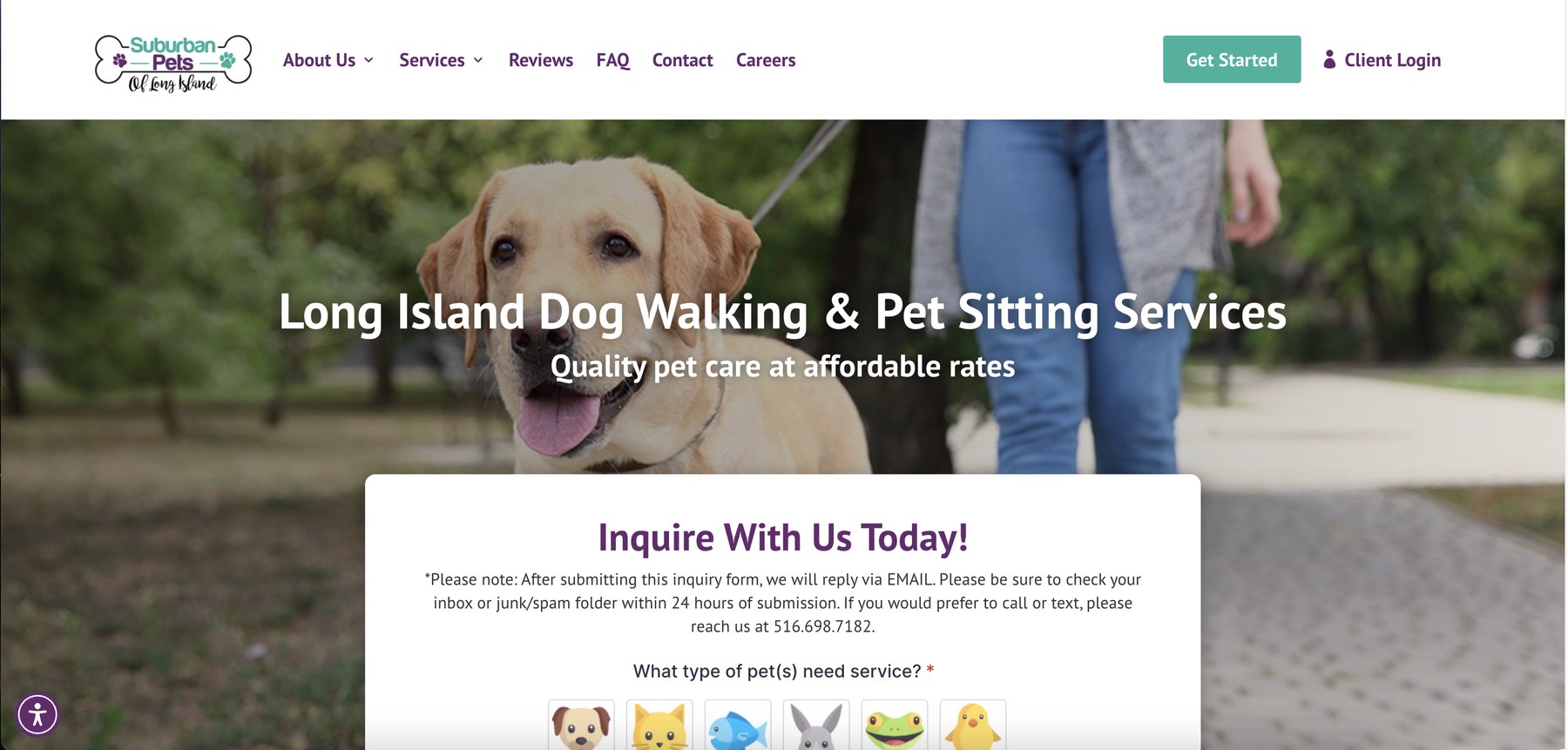
A Long Island pet-care business whose website works against it — the study asked why prospective customers stall before booking.
One of three researchers — heuristic evaluation, five pet-owner interviews, affinity mapping, evidence-based personas, and strategic recommendations.
Three insight themes and four evidence-based recommendations — the final academic research deliverable; not implemented or measured, and none claimed to be.
Academic research study — the veterinary business did not commission or participate in the study. Recommendations await validation.
Users were rejecting uncertainty —
not digital booking.
Three insights — trust, simplicity, service transparency — became four prioritized recommendations: show the caregiver, simplify booking, surface logistics, and clarify communication. The evidence trail follows.
The service felt trustworthy.
The website didn't.
Suburban Pets of Long Island helps pet owners arrange local care — pet sitting, dog walking, grooming. The business runs on warmth and word of mouth.
The website is where that trust broke down: questions about providers, pricing, and logistics went unanswered — so users called, drove over, or left. The study asked why.
The scope of the study — not performance metrics.
02 — The Research Problem
When the website didn't provide enough provider, pricing, transport, or service information, pet owners abandoned it — and called or visited the business instead.
Four questions
set the agenda.
Are users confident choosing providers from the website alone?
Can they complete booking easily on mobile?
What builds — or breaks — trust in an online pet-care service?
Could clearer communication reduce booking anxiety?
Three researchers,
rotating seats.
Three researchers planned together, sat in every interview together, and mapped the data together — while each carried identifiable threads through the work.
- Research planning and business-context analysis
- All five 3:1 sessions — rotating moderator, note-taker, and observer roles
- Affinity mapping, theme grouping, and the final synthesis
- Conducted the heuristic evaluation of the existing site
- Moderated user interviews in my rotations
- Developed the Daniel persona from the mapped evidence
- Shaped recommendations on booking flow, sitter profiles, logistics, and trust
Why the rotation matteredThree perspectives on the same conversation caught behaviors any one of us would have missed.
Three methods,
one evidence trail.
A heuristic audit produced hypotheses; 3:1 interviews produced the evidence; affinity mapping turned it into patterns — and every later step fed off the one before.
- Method
- Semi-structured interviews
- Sample
- n=5 pet owners
- Team
- 3 researchers
- Phase
- Exploratory research
The audit gave us hypotheses —
not conclusions.
I evaluated the existing site against established usability principles. Five issues surfaced — each one became something to listen for in the interviews.
Unclear navigation, limited system feedback
Users can't tell where they are, or whether an action worked.
Would clearer wayfinding keep users off the phone?
Inconsistent, disorganized information
Service details are scattered; comparing options takes real effort.
Reorganize around how owners evaluate care.
Insufficient filtering and user control
No way to narrow by service, location, or logistics.
Give users control over how they explore.
Unclear error and recovery behavior
The inquiry form feels like a commitment with no undo.
Tell users what happens after they submit.
Text-heavy content, difficult to scan
The reassurance users need is buried in paragraphs they won't read.
Surface trust signals where decisions happen.
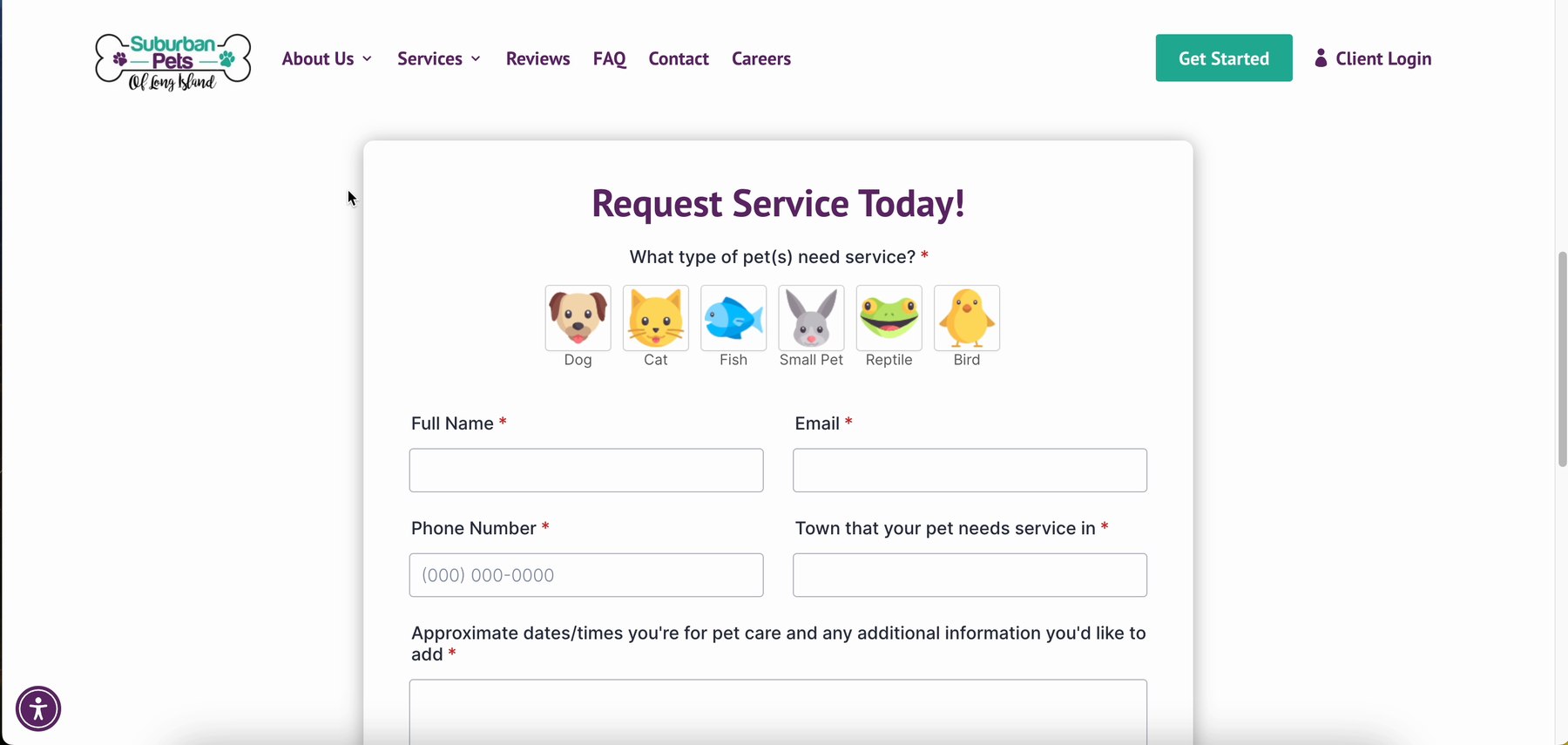
The inquiry form — submitting starts a wait, not a booking.
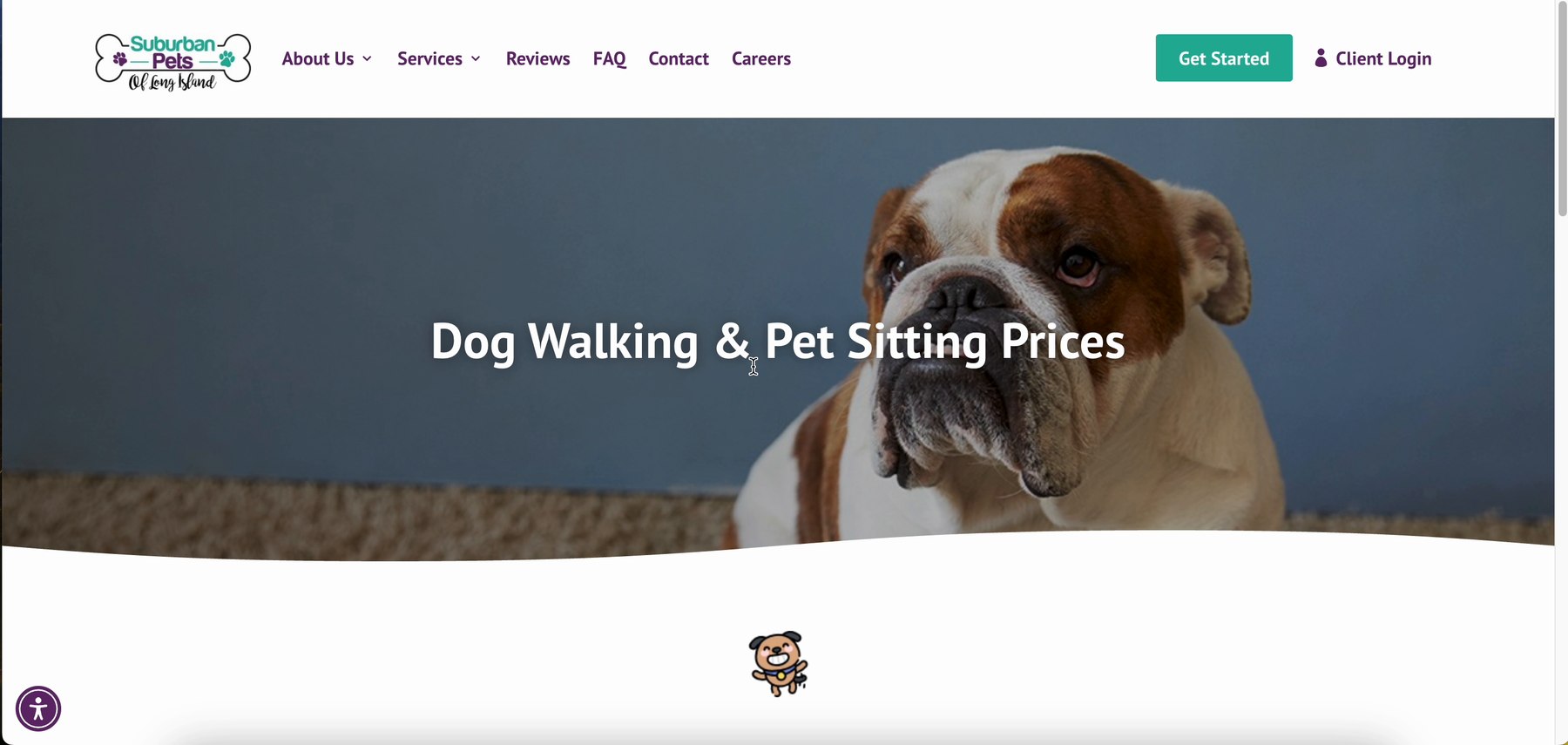
The pricing page — costs live far from the services they describe.
Five owners, three researchers,
one conversation at a time.
Five pet owners walked us through how they find, evaluate, and book care — every session 3:1, with rotating moderator, note-taker, and observer seats.
What these sessions were — and weren'tExploratory interviews about behavior and trust, not usability tests. Task-based validation belongs to the next study.
Every note went on the board.
The board found the patterns.
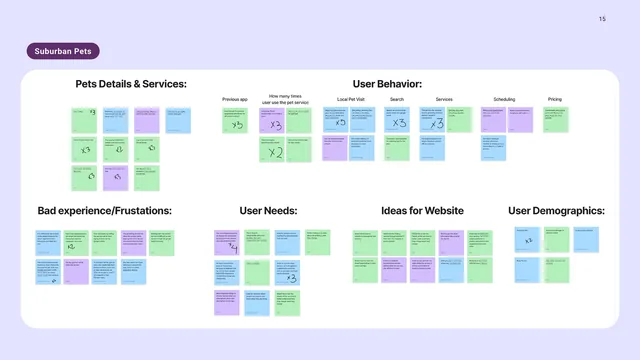
Notes were externalized one observation at a time, then grouped until themes held — what repeated became a pattern; what patterned became a candidate insight.

The affinity map — five interviews, externalized and clustered by the team.
Two owners.
Two reasons to hesitate.
The affinity map kept splitting along one line: logistics or trust. Each side became an archetype — two tensions the same website must resolve.
Persona 01 — The Self-Service, Convenience-Driven Owner
The tension: convenience & logistics
Daniel Kim
32 · Freelance web developer · 3 pets · Long Island
Just getting my pets to the appointment is a whole mission.
Daniel books close to home, leans on family for transport, and sticks with a provider once a routine works.

The tension: trust & emotional safety
Emily Golden
27 · Office manager · One elderly cat · Long Island
I need to know my pet is safe and cared for, not just hope.
After a devastating vet experience, Emily prioritizes human interaction — when a website feels cold, she calls or visits before committing.
Daniel needs the website to be faster. Emily needs it to be warmer. The recommended experience has to be both — in the same screens.
Users weren't rejecting
digital booking. They were
rejecting uncertainty.
Three insights survived the synthesis. Together they explain the phone calls.
Insight 01 — Trust
No face, no booking.
If I don't know who's coming, I'm not booking.
Insight 02 — Simplicity
Booking felt like applying.
I expected to just book and go. Instead, I had to wait.
Insight 03 — Service Transparency
The decision needs logistics.
Observed: users left the site to Google nearby services — or picked up the phone.
Four opportunities,
in priority order.
The final research deliverable: four evidence-based design directions. None of these has shipped, and none is claimed to have.
Priority 01 · The strongest lever
Increase trust visibility
ProblemUsers won't commit to an unknown caregiver — and today, the caregiver is invisible. The evidence: Insight 01.
Put a real person at the moment of commitment:
- Detailed sitter and provider profiles
- Credentials, ratings and reviews
- Pre-booking questions and direct communication
Expected impactThe reassurance Emily currently gets only by phone moves onto the page.
Priority 02 · The core flow
Simplify the booking flow
ProblemBooking reads as a long form followed by silence — a request, not a booking. The evidence: Insight 02.
Make booking feel like booking:
- Fewer, clearer steps with progressive disclosure
- Immediate confirmation and system feedback
- Forms designed for mobile
Expected impactA shorter booking flow could reduce the time and effort required compared with calling — the path Daniel is already looking for.
Priority 03
Surface service logistics
ProblemProximity, transport, pricing, and availability decide the booking — but live nowhere near the decision.
DirectionShow service areas, transport availability, pricing, and availability beside the relevant services.
Expected impactThe comparison users currently do by phone happens on the page.
Priority 04
Improve information architecture & communication
ProblemDense content, unclear navigation, and ambiguous messaging leave users unsure what happens next.
DirectionReorganize dense information, clarify next steps and error recovery, and make service expectations explicit.
Expected impactFewer dead ends — the site answers the questions users currently save for the phone.
The study ends
with better questions.
Exploratory interviews explain behavior; they don't validate solutions. The next stage would put revised concepts in front of persona-matched users.
09 — Reflection
The 3:1 interview format — three perspectives on every conversation meant no single researcher filtered the evidence.
We went in assuming a usability problem and found an information problem. Daniel and Emily fail on the same site for different reasons.
Persona-matched participants and task-based scenarios against the revised booking flow, sitter profiles, and transport filters.
The challenge was never convincing people to care for their pets. It was giving them enough confidence to book online.